For the people who run the room

If you run a food place and want it described clearly here

Foodplacey writes about rooms and menus, not rankings.

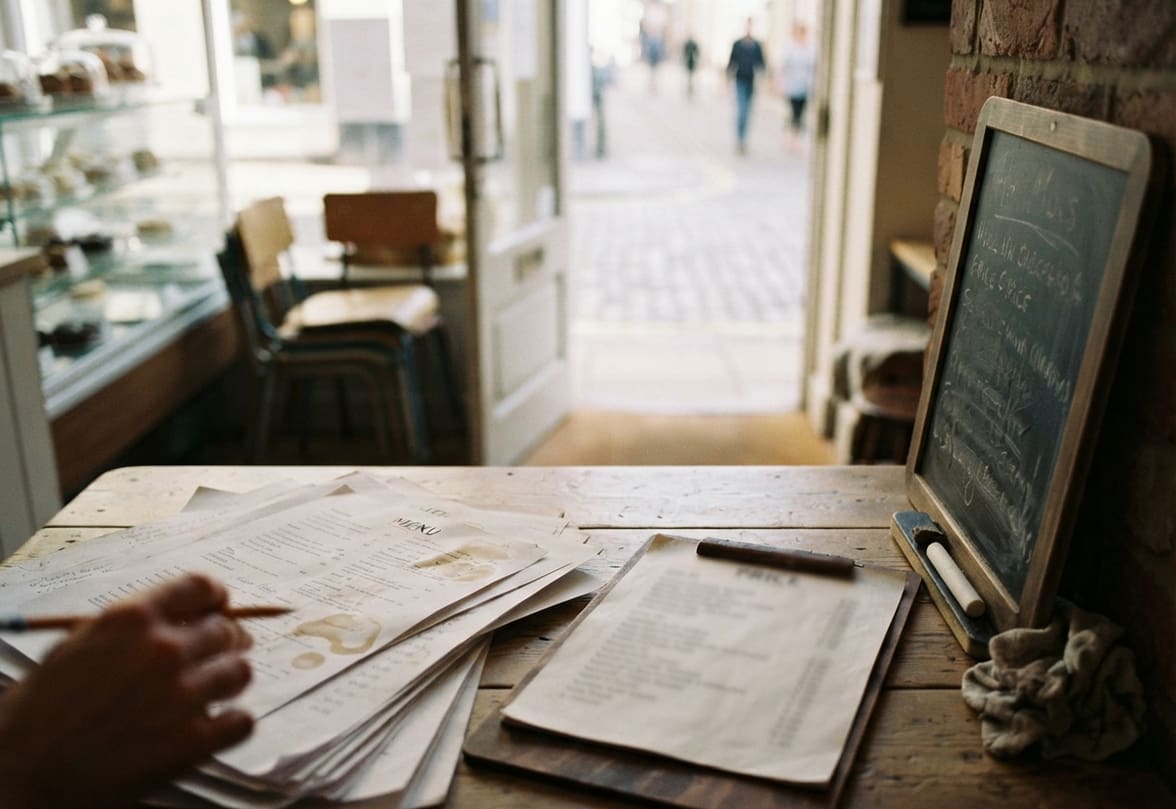
Printed menus spread on a table by an open café door

A listing here is a short, plain picture of what a person walks into. How the room feels at an ordinary hour, roughly where the menu leans once someone has sat down, and the practical things that quietly shape a visit. Diners read that before they set off, and it is usually what decides whether they come to you tonight or carry on scrolling.

The gain for you is a quiet one. Someone who already knows the room is small, that the counter is the main event, or that the kitchen leans one way rather than another is someone who arrives on purpose. Fewer people come in expecting a different sort of evening and leave a little disappointed, and the ones who do come tend to settle in.

None of this asks you to be new, fashionable or busy. It asks the description to match the place.

Two things a listing here is not

Both are worth saying plainly before you spend any time on this.

Not a prize

Being here is not an award

Foodplacey does not score, rate or rank anywhere, so there is no shortlist to reach and nothing to win. A place belongs here when there is enough steady, checkable information to describe it honestly. That is the whole test, and a small room doing one thing well passes it as easily as a large one.

Not for sale

Placement cannot be bought

There is no paid position, no boosted card and no package that lifts a place up a page. Nobody can pay to be written about more warmly either, because the description follows the room rather than the budget. If anyone offers you that in the name of Foodplacey, it did not come from here.

What belongs here

Which kinds of spots make sense on Foodplacey

Everyday places people go to on purpose to eat or drink.

Restaurants of every size, cafes, bakeries, bars with a kitchen that means it, counters, lunch windows, dessert stops and the small rooms that never sit neatly in one category. If a person can walk in, sit down or stand at your counter and make a meal or a drink of it, it fits here.

  • Restaurants
  • Cafes
  • Bakeries
  • Bars that cook
  • Counters and lunch windows
  • Dessert stops

Kitchens that exist only inside a delivery app are the awkward case. There is no room to describe and nothing for anyone to walk into, so most of what a listing here is for simply does not apply to them.

What helps in writing a listing worth reading

  • A steady offer. Not a menu frozen forever, but a kitchen that does a recognisable kind of thing week to week, so a sentence written today still holds next month.
  • A usual atmosphere. Something you could describe on an ordinary evening without it sounding like a different place on a different night.
  • A public way to check. A site, a menu page or a listing you keep up to date, so a reader can confirm hours and details for themselves instead of taking anybody's word for it.

If a place is not added straight away, it is nearly always because there is not yet enough steady information to describe it usefully, not because somebody weighed it up and thought less of it. Rooms that have only just opened often sit in that gap for a while, and it tends to close on its own.

Worth having to hand

What to gather before you get in touch

A few minutes of gathering saves a long thread of questions.

Have these in front of you

  1. The exact name. Spelled and punctuated the way it appears above your door, including the part people usually drop in conversation.
  2. The address. The full one, plus a word about where it actually is if the street name on its own would send somebody to the wrong end of it.
  3. One public link. Your own site, or the page where your menu lives. One link you keep current is worth more than three that disagree with each other.
  4. A few grounded words on the feel. How many tables, how loud it usually gets, whether people linger or turn over, what an ordinary weekday lunch looks like from the door.
  5. The practical notes that change a visit. Mostly takeaway, counter seating only, cash at the till, a step at the entrance, a kitchen that stops early. The things somebody would want to know before walking over.

Write it the way you would say it

The most useful sentences are the ones you would say to a friend who asked what your place is like. Concrete, a little unglamorous, easy to picture. Something along these lines, in your own words:

A narrow room with a counter at the front and a handful of tables behind it. Busy from noon until early afternoon, quiet after that. The grill does most of the work, and there is not much space for a pushchair.

Set that against a line about warm hospitality and the finest ingredients, which could belong to any place anywhere and gives a reader nothing to picture. Adjectives are hard to check and easy to skip past. The shape of a room, the rhythm of a day and what the kitchen actually leans on are neither.

No pressure

It does not have to read well

You are not writing the listing, you are handing over what you know. Rough notes, half sentences and a link are plenty.

What you send is treated as one source among others and read alongside your own public pages, then turned into the site's plain wording. Nothing you write goes up as marketing copy in your name.

Sending it in

How to ask for a new or updated listing

Four short steps, with no promise attached to any of them.

  1. Open a message to the address this site publishes

    Use the contact route rather than a reply on social media, so the details stay in one place and can be found again later.

  2. Say whether this is a new place or a correction

    One line at the top does it. A correction is far quicker to act on when it names what currently reads wrong and what it should say instead.

  3. Paste in the details you gathered above

    Name, address, one public link, the few grounded words, the practical notes. All of it in the message itself rather than spread across attachments.

  4. Keep one message to one place

    If you run more than one room, send them separately. Two venues in one thread is how one of them ends up missed.

Every message is read. Not every message turns into a visible change, and it is fairer to say that here than to let you assume otherwise. Sometimes there is still not enough solid information to describe a place usefully, and sometimes what arrives does not agree with what your own public pages say. When that happens the site waits rather than guessing.

Write to somewhere@foodplacey.com. That is the only address Foodplacey uses, for venue teams and diners alike.

Please keep the contents to what describes a public food place. No personal details about staff or customers, no identity documents, no card or bank information, and nothing you would not be happy to see written on your own front window.

The same inbox takes questions from diners, so a subject line naming the venue keeps yours easy to find again.

See what else that inbox handles

Both sides of the door

What a clear description does for you and your guests

The same few honest sentences do two jobs at once.

When a place is described in everyday, truthful terms, the person choosing has an easier evening and so does the team that welcomes them. They turn up with the right expectations, ask fewer questions at the door, and are much less likely to have picked the wrong room for the night they are actually having. A listing that oversells does the opposite to everyone involved in it.

Rooms change. Kitchens change hands, hours move with the seasons, a counter grows into a dining room. If what is written here ever stops matching what you do, come back to this page, gather the same handful of details and follow the steps again. Asking for a correction is the same short message as asking to be added in the first place.

And thank you to everyone who takes the time over it. Most of what makes this site worth reading comes from people who run places and would rather be described plainly than described well.

Back to the steps